


A customer asked: "The power frequency air compressor we used before, the boss felt that the electricity bill was too high. I heard that permanent magnet inverter can save 30% energy, and I want to replace it. Is this true?" This is a very real question. Many customers purchase air compressors. In addition to paying attention to the price, manufacturer and after-sales service, the electricity bill during actual use is what they are more concerned about.
In the entire life cycle cost of an air compressor, electricity costs account for as much as 75%-80%, and equipment purchase costs only account for about 12%. If 30% of electricity costs can be saved, it will be a huge benefit for any factory.
As a professional screw air compressor manufacturer, let us explain in detail how the permanent magnet variable frequency screw air compressor saves 30% energy. "Energy saving 30%" is never an empty advertising slogan, but comes from the synergy of three core technologies.
I we need to understand where the electricity costs of traditional fixed-frequency air compressors go.
To understand how permanent magnet variable frequency drives save electricity, we must first understand how traditional fixed-frequency compressors waste electricity. The motor speed of a fixed-frequency air compressor is always constant; regardless of the amount of air used, the motor runs at full speed. When air consumption is insufficient, the only way to "unload" is by closing the intake valve-but in this unloaded state, the motor is still idling, and the no-load power still accounts for 40%-50% of the rated power. For example, if your workshop only uses half the air, but the air compressor consumes 80% of the electricity, this is the biggest source of waste. Besides this, there are two other major losses:
(1) Pressure redundancy loss:
The pressure bandwidth of a fixed-frequency compressor is usually ±0.2-0.5 bar. During use, to avoid insufficient pressure, it is often set too high, and for every additional bar of pressure, energy consumption increases by about 7%.
(2) Motor efficiency loss:
The efficiency of traditional asynchronous motors drops significantly under partial load; at 50% load, the efficiency is only about 80%, and a large amount of electrical energy is converted into heat energy and wasted.
II. How do permanent magnet variable frequency air compressors save energy?
Technology 1: Variable Frequency Speed Control – Reducing Idle Waste
This is the core of energy saving in permanent magnet variable frequency air compressors. It uses a frequency converter pressure sensor to monitor pipeline pressure in real time and automatically adjusts the motor speed according to actual air consumption – the speed decreases when air consumption decreases and increases when air consumption increases, thus achieving "on-demand air supply" and reducing idle waste.
The key difference between fixed frequency and permanent magnet variable frequency compressors is:
- Fixed frequency compressors close the intake valve when air consumption is insufficient, resulting in 45% power wastage during motor idling;
- Permanent magnet variable frequency compressors directly reduce the speed, reducing idle power to less than 10% of rated power.
The greater the fluctuation in air consumption, the more significant the energy-saving effect of permanent magnet variable frequency compressors.
This is also the largest contributor to the 30% energy saving of permanent magnet variable frequency compressors.
Technology 2: Permanent Magnet Synchronous Motor – Improving Motor Efficiency
Permanent magnet variable frequency air compressors use rare-earth permanent magnet materials (such as neodymium iron boron) to replace the excitation windings of traditional asynchronous motors. No current flows through the rotor, fundamentally eliminating rotor excitation losses. Motor efficiency can reach over 95%, 8%-12% higher than traditional asynchronous motors.
Moreover, it maintains high efficiency even under partial load conditions. For example, at 50% load, the efficiency of a permanent magnet motor can reach over 90%, while an asynchronous motor typically only reaches around 80%. For factories with fluctuating air consumption, the long-term cumulative energy difference will be very significant.
| Comparison items | Traditional industrial frequency air compressor | Permanent magnet variable frequency air compressor |
| Motor type | Asynchronous motor | Permanent magnet synchronous motor |
| Motor efficiency | Approximately 85%-90% | 95%以上 |
| 50% load efficiency | Approximately 80% | More than 90% |
| No-load power | Rated power 40%-50% | Within 5% of rated power |
| Transmission method | Belt/gear drive (85%-90%) | Direct drive (100%) |
Technology 3: Precise constant pressure control – eliminating pressure redundancy
The permanent magnet variable frequency air compressor controls the pressure fluctuation within ±0.01-0.1bar through the PID closed-loop control system. However, in order to ensure pressure stability, traditional industrial frequency machines often need to set up an additional 0.3-0.5bar redundant pressure. According to industry data, every time the operating pressure is reduced by 1 bar, energy consumption can be reduced by approximately 7%. Constant voltage control seems inconspicuous, but it is actually an important part of energy saving.
Therefore, a comprehensive 30%-40% energy saving = variable frequency speed regulation eliminates no-load + permanent magnet motor improves efficiency + constant voltage control eliminates redundancy.
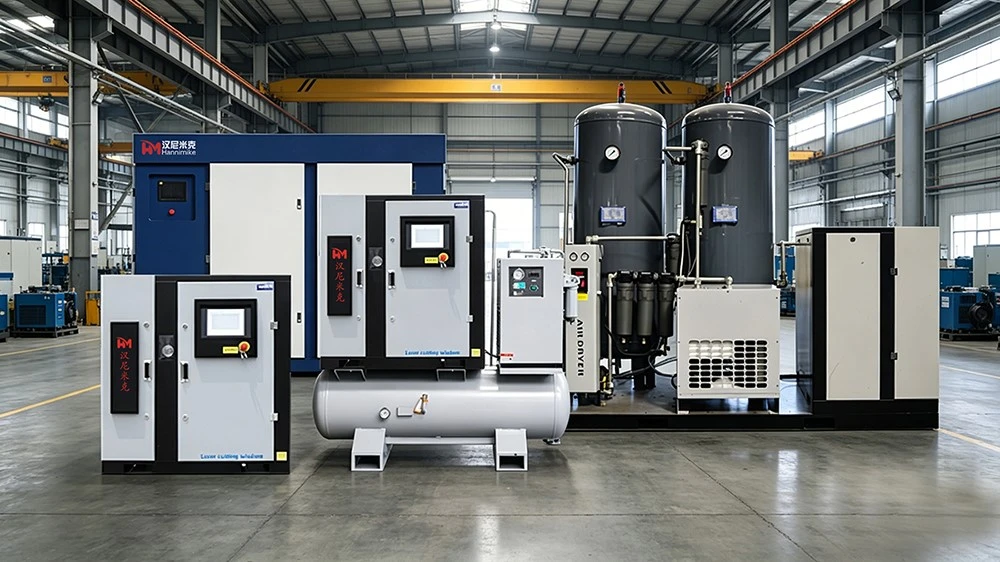
Hannemec permanent magnet variable frequency screw air compressors utilize a brand-name permanent magnet synchronous motor and a domestically renowned Huichuan frequency converter for energy saving. This configuration is considered high-end among permanent magnet variable frequency air compressors, and is particularly favored in the laser cutting field!


Besides the motor and frequency converter, the following features are also designed for energy saving:
(1) Customized high-performance screw compressor: high precision, low vibration, stable operation, and ultra-long service life.
(2) Heightened oil-gas separator: lower pressure loss, reducing system internal consumption.
(3) Optimized pipeline design: good sealing, precise response, and reduced unnecessary air volume loss.
(4) Enlarged and thickened radiator: prevents high-temperature failures, especially suitable for high-temperature and high-humidity environments, ensuring long-term stable operation of the permanent magnet motor under variable frequency conditions and avoiding high-temperature failures.
III. Important Reminder: 30% Energy Saving by Permanent Magnet Variable Frequency Drives Has Prerequisites
"30% energy saving" does not apply to all operating conditions. The energy-saving effect of permanent magnet variable frequency drives is directly related to fluctuations in gas consumption:
| Gas usage conditions | Energy efficiency | Is it recommended? |
| Gas consumption fluctuations >30%, intermittent production | 20%-40% | Highly recommended |
| Gas consumption varies between day and night, with peaks and troughs. | 15%-30% | Recommend |
| Stable gas supply at full capacity 24 hours a day | <5% | Power frequency is more cost-effective |
If your factory operates at full capacity 24/7 with short loading/unloading times, the energy consumption difference between fixed-frequency and variable-frequency motors is minimal. In this case, buying a fixed-frequency motor is cheaper and more cost-effective.
Therefore, don't blindly switch to a variable-frequency motor just because others say permanent magnet motors are energy-efficient. Choose based on your factory's actual operating conditions.
IV. Common Customer Questions
Will permanent magnet motors demagnetize over time?
Reputable manufacturers use permanent magnets with a 180℃ temperature resistance design, ensuring a lifespan of over 15 years under normal operating conditions. When purchasing, pay attention to whether the manufacturer uses high-quality neodymium iron boron materials and a standardized temperature control design.
Will maintenance costs be higher after switching to a permanent magnet motor?
Permanent magnet motors use direct drive, eliminating belts, gears, and other easily damaged parts. They offer 100% transmission efficiency and require no bearing maintenance, resulting in lower mechanical maintenance costs. While the frequency converter requires periodic calibration, overall maintenance costs are usually lower than for fixed-frequency motors.


