


With its advantages of high speed, good cutting effect, simple operation and low maintenance cost, laser cutting machine has become the mainstream technology in the cutting industry. Laser cutting has also made the requirements for the pressure, flow rate, cleanliness and dryness of compressed air more stringent, because the quality of the air source directly determines the quality of the cutting surface, the life of the nozzle/lens and the equipment failure rate. So, how to choose a suitable air compressor?
I. Determine the power of the laser cutting machine
|
Laser cutting power |
Compatible with air compressors |
Gas production |
|
≤1500w |
11kw 16bar |
1.0m³/min |
|
≤3000w |
15kw 16bar |
1.2m³/min |
|
3000w |
15kw 16bar |
1.5m³/min |
|
4000w~6000w |
22kw 16bar |
2.2m³/min |
|
12000w |
22kw 16bar |
2.2m³/min |
|
20000~30000w |
37kw 16bar |
3.5m³/min |
II. Selection of Air Compressor Main Unit Type
Screw air compressors are preferred for continuous laser cutting operations:
1. Permanent Magnet Variable Frequency Screw Air Compressor (First Choice)
Advantages: Stable air pressure, low energy consumption, minimal pressure fluctuations, suitable for long-term uninterrupted cutting, and the mainstream choice in the laser industry.
Suitable for: Factories operating at full capacity for extended periods, multiple machines sharing an air source.
2. Industrial Frequency Screw Air Compressor
Advantages: Lower price, simpler structure, and easier maintenance.
Suitable for: Intermittent operations, low-power laser machines, and budget-constrained scenarios.
III. Essential Post-Processing Purification System (Even More Important Than the Air Compressor)
A standard laser purification system includes:
1. Refrigerated dryer (cooling and dehumidification)
2. Precision filter (dehumidification + dust removal + oil removal)
3. Air tank (pressure stabilization, buffering)
4. Adsorption dryer (mild heating/heatless) – a must for high-power lasers
As a professional manufacturer of air compressors for laser cutting machines, what are the features and advantages of Hannemec's two best-selling screw air compressors?
1. Four-in-one integrated screw air compressor
(1) Permanent magnet synchronous integrated motor
(2) Adopts INOVANCE frequency converter, achieving energy savings of 30%-40% through frequency conversion control alone.
(4) Integrated design, small footprint, easy to install and maintain
(5) 340L air tank, thickened material, corrosion-resistant and more durable
(6) Plate heat exchanger refrigerated dryer, excellent water removal effect
(7) Five-stage precision filtration, maximizing protection for your laser cutting machine.
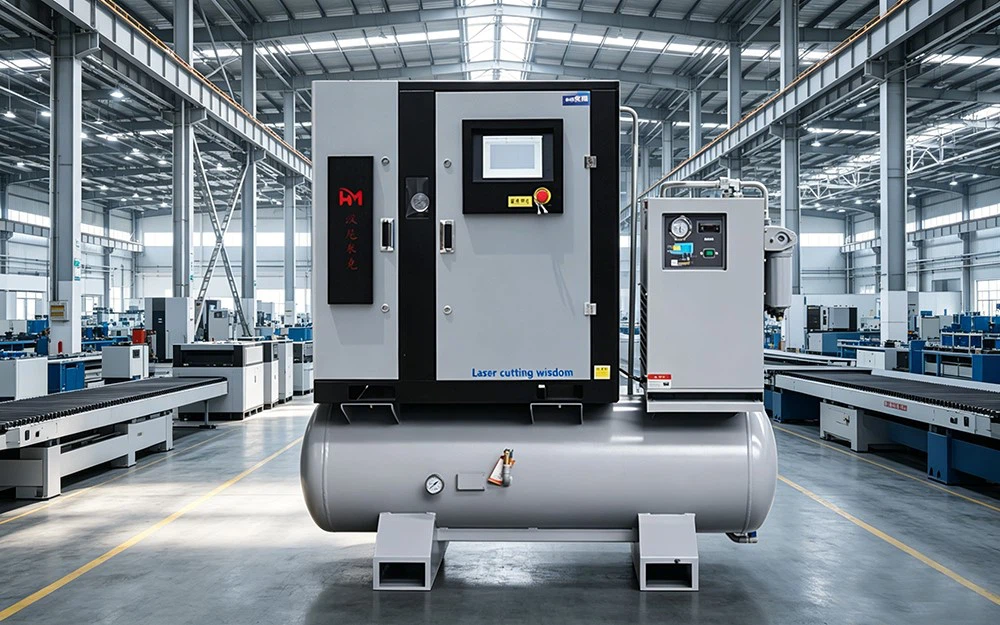
|
Product Parameters |
||||||||||
|
Model |
HM15 |
HM20 |
HM30 |
|||||||
|
Power |
hp |
15 |
20 |
30 |
||||||
|
|
kw |
11 |
15 |
22 |
||||||
|
Work pressure(Bar) |
13 |
16 |
13 |
16 |
20 |
30 |
13 |
16 |
20 |
|
|
Flow(m3/min) |
1.0 |
0.9 |
1.6 |
1.2~1.5 |
0.9 |
1.1 |
2.4 |
2.2 |
1.8 |
|
|
Type |
Single-stage |
|||||||||
|
Cooling method |
Air Cooling |
|||||||||
|
Tank(L) |
340 |
|||||||||
|
Weight(kg) |
415 |
425 |
455 |
|||||||
|
Size(mm) |
1760×700×1600 |
1800×700×1760 |
1800×750×1760 |
|||||||
2. Skid-Mounted Screw Air Compressor
(1) Customized eight-bearing main unit: high precision, good stability, low vibration, and more stable operation.
(2) PM VSD series uses INOVANCE frequency converter; energy saving rate can reach 30%-40% through frequency conversion control alone.
(3) Maximum pressure can reach 20 bar, effectively assisting laser cutting machines in completing cutting work.
(4) Uses an eight-stage precision filter; oil, water, and dust removal rate can reach 0.001μm.
(5) 600L dry and wet dual air tank: large capacity, corrosion-resistant, more durable, buffering, cooling, water removal, and stable air pressure.
(6) Combined design of plate heat exchanger refrigerated dryer and modular desiccant dryer, providing more efficient drying effect, energy saving, environmental protection, and higher compressed air cleanliness.
(7) Five-in-one integrated design, easy to install and maintain.
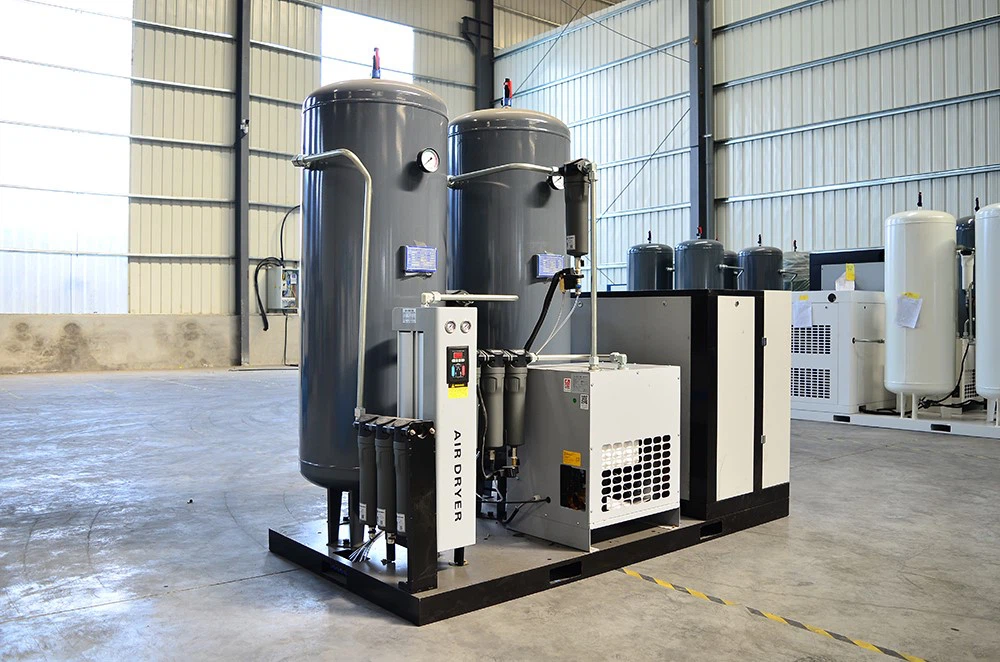
|
Product Parameters |
|||||||||
|
Model |
HM30 |
HM50 |
HM60 |
||||||
|
Power |
hp |
30 |
50 |
60 |
|||||
|
|
kw |
22 |
50 |
60 |
|||||
|
Work pressure(Bar) |
16 |
20 |
16 |
20 |
16 |
20 |
|||
|
Flow(m3/min) |
2.2 |
1.8 |
3.5 |
3.2 |
5.0 |
4.8 |
|||
|
Type |
Single-stage |
||||||||
|
Cooling method |
Air Cooling |
||||||||
|
Tank(L) |
600×2 |
||||||||
|
Weight(kg) |
800 |
1080 |
1120 |
1380 |
1430 |
||||
|
Size(mm) |
1760×700×1600 |
2800×1400×2500 |
2800×1400×2500 |
||||||
I. Precautions for Daily Use of Air Compressors
Pre-start Inspection
1. Check oil level: Maintain lubricating oil between the upper and lower marks on the oil level gauge. Add the same type of dedicated machine oil if insufficient.
2. Check pipelines and valves: Ensure air pipes and joints are leak-free and secure. Ensure drain valves are closed.
3. Confirm power supply and grounding are normal. Ensure belts/couplings are secure and there are no abnormal noises.
Operation During Operation
1. No-load start: First, open the exhaust valve and start the machine under no-load. Gradually increase load after the machine runs smoothly.
2. Observe parameters: Pressure, temperature, and voltage should be normal. Immediately stop the machine if the body temperature is too high, abnormal noises occur, or there is severe vibration.
3. Overpressure is strictly prohibited: The pressure must not exceed the rated pressure on the equipment nameplate.
4. Ventilation and heat dissipation: Leave sufficient space around the machine for heat dissipation. Do not obstruct the air inlet.
5. Operate under the supervision of designated personnel. Do not leave the area unattended. Children and unauthorized personnel are prohibited from touching the operating equipment.
Shutdown and Routine Maintenance (Daily Required)
1. Normal Shutdown: Unload first, then shut down; do not stop abruptly while pressurized.
2. Daily Drainage: Drain water from the air tank, pipelines, and bottom of the filter to prevent water accumulation, corrosion, and impact on air quality.
3. Cleaning: Clean dust from the machine body and air filter surface to ensure unobstructed air intake.
Long-Term Shutdown: Disconnect the power supply and release residual pressure in the tank.
I. Air Compressor Maintenance Precautions
(1) Regular Maintenance Cycle
• First maintenance for new machines: After 500 hours of operation, replace the air filter, oil filter, and lubricating oil, and inspect key components.
• Standard maintenance interval:
• Every 2000 operating hours, completely replace the air filter, oil filter, oil separator, lubricating oil, and filter element, and blow out the radiator and cooling fan. Perform a systematic inspection and maintenance of the main unit.
• Time-based maintenance: Even if the required operating hours have not been reached, the cooling system should be inspected every 6 months.
(2) Special Operating Condition Adjustments
• Dusty environments: Reduce the air filter replacement interval to 1000 hours, and weekly cleaning and inspection are recommended.
• Frequent start-stop conditions: Conduct a special inspection of the electrical system every 1500 hours.
• Continuous high-load operation: Compress the lubricating oil replacement cycle to 2000 hours and increase the frequency of oil quality testing.


