


1. Where Does Moisture in Compressed Air Come From?
Natural air contains water vapor. When an air compressor intakes and compresses air, the gas volume shrinks drastically while the total amount of water vapor remains unchanged, which sharply raises the relative humidity of compressed air . As high-temperature compressed air flows through pipelines and cools down naturally, water vapor condenses into liquid water - this follows fundamental physical laws.
Consequences of insufficient moisture removal:
Equipment: Pipeline corrosion, lubrication failure and jamming of pneumatic components.
Processes: Dross formation during laser cutting, blistering or poor adhesion in coating applications.
Quality control: Risk of microbial growth in food, pharmaceutical and similar industries, endangering product safety.
Operation & maintenance: Pipeline icing in winter, heavier filter load and sharp increase in maintenance costs.
Air compressors only compress air and cannot remove moisture; compression itself accelerates water condensation. Even high-quality compressor units will underperform without proper post-treatment. To guarantee system stability, lower life-cycle costs and improve product yield, it is a necessary investment to select either a refrigerated compressed air dryer or a desiccant compressed air dryer according to compressed air quality requirements.
Neither refrigerated compressed air dryers nor desiccant compressed air dryers are universally superior. Selection depends entirely on a plant's compressed air quality requirements.
2. Core Difference Between Refrigerated Compressed Air Dryer and Desiccant Compressed Air Dryer: Drying Mechanism
Though both devices remove moisture from compressed air , they operate on completely different technical principles.
A refrigerated compressed air dryer adopts cooling-condensation technology. Its refrigeration system cools compressed air so that water vapor condenses into liquid water and is drained out. Under standard working conditions, its outlet pressure dew point (PDP) typically reaches 2℃ ~ 10℃. Note that its actual dew point is heavily affected by inlet-air temperature and ambient temperature. For sizing, it is recommended to design for a usable margin of +10℃.
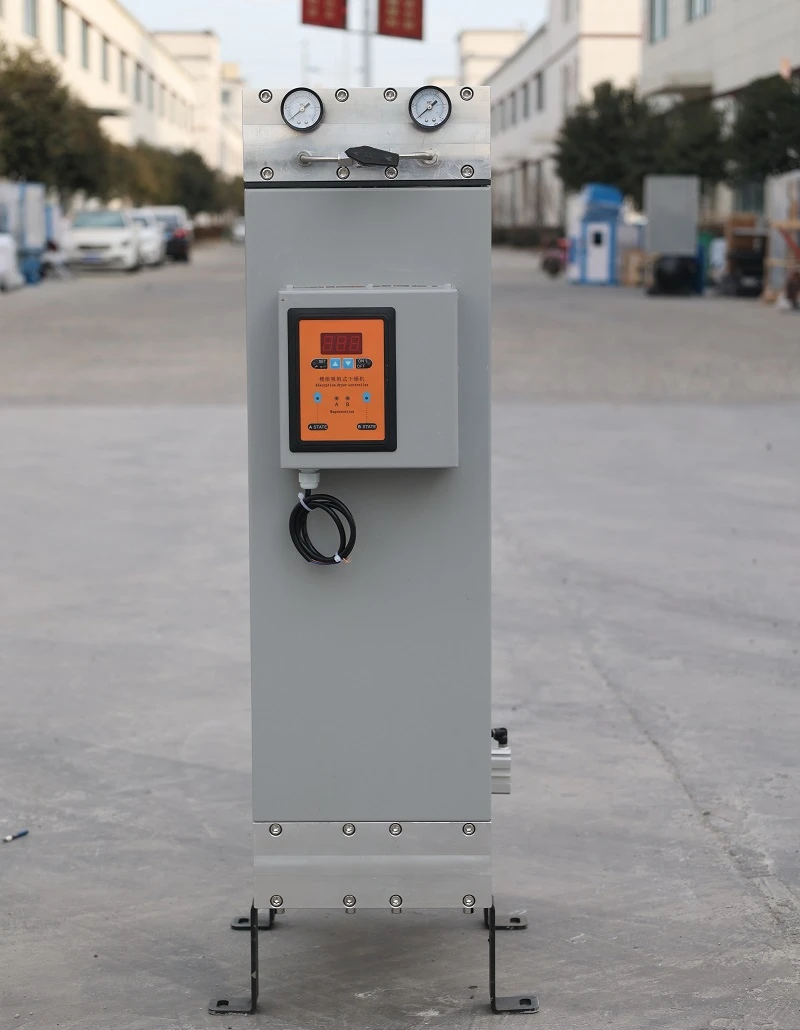
A desiccant compressed air dryer relies on adsorption dehumidification. Compressed air passes through adsorption towers filled with desiccants (activated alumina, molecular sieve, etc.) where water vapor is trapped for deep drying. Saturated desiccants require regeneration, so desiccant compressed air dryers commonly use dual-tower alternating operation to deliver continuous air supply.
Simply put: refrigerated compressed air dryers"condense water out", while desiccant compressed air dryers "adsorb water out". This is the root cause of their performance gaps.
| Comparison Item | Refrigerated Compressed Air Dryer | Desiccant Compressed Air Dryer |
| Drying Principle | Moisture removal via refrigeration and condensation | Moisture capture by desiccant adsorption |
| Typical Pressure Dew Point (PDP) | 2℃ ~ 10℃ | -20℃ ~ -70℃ |
| Energy Consumption | Relatively low, largely constant | Varies greatly with regeneration type |
| Operating Cost | Relatively low | Variable by model |
| Maintenance | Simple; regular radiator cleaning and drain-valve inspection | Desiccants require periodic inspection, replenishment or replacement |
The most critical distinction lies in achievable pressure dew point. The lower the pressure dew point, the drier the compressed air . Conventional refrigerated compressed air dryers deliver 2℃-10℃ PDP, whereas desiccant compressed air dryers can reach -20℃, -40℃ or even lower. Desiccant compressed air dryers become mandatory when processes demand extremely dry compressed air .
Tip: Do not confuse Atmospheric Dew Point (ADP) and Pressure Dew Point (PDP). ADP refers to dew point under atmospheric pressure; PDP refers to dew point under working pressure. Values differ significantly. At 0.7 MPa network pressure, -20℃ PDP equals approximately -45℃ ~ -50℃ ADP. Always verify whether product datasheets quote PDP or ADP to avoid wrong selection.
3. Energy-Consumption Variations of Desiccant Compressed Air Dryers
The statement "desiccant compressed air dryers consume much energy" is not universally valid. Multiple regeneration technologies yield vastly different energy-consumption profiles:
Traditional dual-tower heat-less desiccant compressed air dryer : Simple structure and low initial investment. High purge-air consumption accounting for 15%-20% of treated air flow; short switching cycles (4-10 min). Suitable for small-to-medium air-flow volumes and applications with loose energy-saving requirements.
Heated-purge desiccant compressed air dryer : Adds auxiliary heaters on the basis of heat-less regeneration. Purge-air consumption drops notably to 5%-8% of treated flow. Suitable for medium-flow-rate scenarios with moderate operating-cost concerns.
Blower-purge desiccant compressed air dryer : Draws ambient air heated by blowers as regeneration medium. Very low purge-air consumption (1%-3% of treated flow) yet relatively high power draw and large footprint. Optimized for large-flow-rate systems ≥100 m³/min.
Compression-heat desiccant compressed air dryer : Utilizes high-temperature compressed-air exhaust from air compressors (120℃-150℃) as regeneration heat source. Almost no extra electric power for regeneration, minimal purge-air loss and lowest overall operating cost. Must pair with oil-free compressors and requires adequate compressor discharge temperature. Higher upfront cost but obvious long-term return.
Waste-heat desiccant compressed air dryer : Similar to compression-heat regeneration but accepts diverse waste-heat sources (compressor cooling-water waste heat, flue-gas waste heat, etc.). Excellent energy-saving performance, yet subject to available system waste-heat and requires thermal-balance calculation.
For large-scale continuously operating plants, energy loss caused by regeneration purge-air can far exceed the dryer's own power consumption. Therefore, when selecting desiccant compressed air dryers , do not only evaluate purchase price; prioritize whole-life-cycle operating costs.
4. How to Choose a Compressed Air Dryer for Laser Cutting Machines
Desiccant compressed air dryers are not compulsory for all laser-cutting machines. Selection shall comprehensively consider laser power, material type, machining accuracy and compressed air quality requirements.
Functions of compressed air for laser cutting include: blowing away molten metal dross, protecting laser-head nozzles, optimizing cut-section quality, and supporting switch-over between oxygen/nitrogen assist-gas. Moisture-related risks include condensation contamination near nozzles, unstable high-pressure airflow and increased maintenance frequency for long-run production.
| Refrigerated compressed air dryers are generally sufficient for | Desiccant compressed air dryers are recommended for |
| Low-power laser-cutting machines | High-power laser cutting (e.g. 12 kW, 20 kW and above) |
| Ordinary carbon-steel processing | Precision machining of stainless steel and aluminum alloys |
| Stable ambient-temperature conditions | High-quality-demand or export-oriented orders |
| General compressed air quality requirements | Non-stop long-duration production |
| -- | Factories located in cold northern regions |
| -- | Processes where compressed air partially replaces nitrogen or oxygen assist gas |
Drying-equipment selection for laser cutting shall be application-specific rather than applying a one-size-fits-all rule.
5. Application Segmentation: Refrigerated Compressed Air Dryers vs. Desiccant Compressed Air Dryers
| Equipment Type | Applicable Industries / Scenarios | Typical Dew-point Requirement | Selection Rationale & Features |
| Refrigerated Compressed Air Dryer | Mechanical manufacturing, hardware processing, auto repair, general pneumatic equipment, CNC machining, pneumatic actuation, air blowing, non-precision assembly | No ultra-low dew-point demand (+2℃ ~ +10℃ achievable) | Low capital outlay, low energy cost and simple maintenance. Fit for temperate-climate environments where compressed air does not directly contact end-products. |
| Desiccant Compressed Air Dryer | Food & beverage, pharmaceutical manufacturing, semiconductors, electronics manufacturing, lithium-battery production, instrument-air systems, outdoor pipelines in cold climates | PDP down to -20℃ or even -40℃ and below |
Processes are highly moisture-sensitive. Deep drying ensures product quality and stable equipment operation, especially for low-temperature environments and precision manufacturing. |
6. Can Refrigerated Compressed Air Dryer and Desiccant Compressed Air Dryer Be Used in Series?
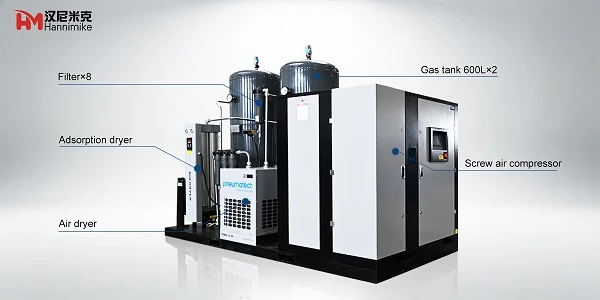
Yes. Many high-grade compressed air systems adopt this combined configuration. HNM's skid-mounted variable-frequency screw-air-compressor packages integrate refrigerated compressed air dryer plus desiccant compressed air dryer .
Working logic of this combination:
The refrigerated compressed air dryer performs primary treatment: it cools air to condense most liquid water and partial oil mist, lowering PDP from approximately 40℃ at compressor outlet down to around 3℃. This drastically reduces the moisture load on downstream desiccant compressed air dryers.
The desiccant compressed air dryer performs polishing treatment: residual trace water vapor is deeply adsorbed to reach -20℃ ~ -70℃ PDP.
The upstream refrigerated compressed air dryer protects the downstream desiccant unit; the downstream unit guarantees final air quality. This serial arrangement extends desiccant service life and lowers overall energy consumption.
Note: Serial configuration is determined by required compressed air quality grade and is not universally necessary. Stand-alone refrigerated compressed air dryers satisfy most ordinary industrial uses. Combined setups are only justified for strict-quality-requirement applications.
7. Enterprise-Oriented Selection Guidelines for Compressed Air Drying Equipment
Enterprises may answer three core questions to narrow down drying-equipment choices:
Does compressed air come into direct contact with products? If compressed air merely drives cylinders, valves or general pneumatic tools, refrigerated compressed air dryers usually suffice. If air directly participates in food processing, pharmaceutical production or electronics manufacturing, desiccant compressed air dryers should be prioritized.
What pressure-dew-point level is required? For standard-grade industrial compressed air (≥+3℃ PDP), refrigerated compressed air dryers are adequate. When customer specifications or industry standards demand -20℃, -40℃ or lower PDP, select desiccant compressed air dryers .
Prioritize upfront investment or long-term operation? Refrigerated compressed air dryers feature lower procurement and operating costs and fit most general-purpose industrial users. Desiccant compressed air dryers demand higher initial capital expenditure. Nevertheless, by choosing appropriate regeneration modes (e.g. modular heat-less regeneration with on-demand loading under partial-load conditions), long-run expenses can be kept reasonable while stable ultra-dry compressed air supply is secured - a critical guarantee for high-end manufacturing.
8.Conclusion: No Universal Best Compressed Air Dryer, Only the Most Suitable Solution
Refrigerated compressed air dryers and desiccant compressed air dryers are not mutually-exclusive alternatives; they deliver differentiated solutions for diverse application requirements.
Refrigerated compressed air dryers offer cost-effective moisture removal for most general-purpose industrial scenarios. Desiccant compressed air dryers are preferred when processes call for lower pressure dew points and superior compressed air cleanliness.
As manufacturing evolves toward higher precision and cleanliness, compressed air drying technologies keep advancing. Modular desiccant compressed air dryers attract growing market attention for their energy-saving performance, operational flexibility and easy maintenance. For factories with volatile air-flow demand, modular solutions exhibit outstanding comprehensive energy efficiency under partial-load conditions and deserve thorough evaluation during new-equipment procurement or system retrofitting.
9. CTA Block - Request a Free Technical Consultation
Unsure Which Compressed Air Dryer Fits Your Plant?
Talk to our compressed air engineers to calculate your Pressure Dew Point requirement and customize an energy-saving compressed air drying solution for your facility. Whether you need a refrigerated compressed air dryer, a desiccant compressed air dryer, or a combined serial configuration, our engineering team will help you determine the right ISO 8573-1 air quality class and optimize your Total Cost of Ownership (TCO) .


