


According to Grand View Research, the global air compressor market reached approximately USD 27.8 billion in 2025. It is projected to hit USD 29.0 billion in 2026 and grow to around USD 40.2 billion by 2033, representing a compound annual growth rate (CAGR) of 4.8% from 2026 to 2033. By region, the Asia-Pacific region retains market dominance, accounting for 42.8% of global revenue in 2025, with China standing as one of the world's key air compressor markets.
A CAGR of merely 4.8% indicates that the air compressor industry is not on a high-speed, explosive growth track. Rather than pure market expansion, the structural shift in underlying demand deserves greater industry attention.
In the past, enterprises prioritized power rating, pressure, flow rate, price and brand when purchasing air compressors.
Today, however, growing numbers of enterprises are asking:
- What will be the long-term operating cost of this air compressor?
- What quality of compressed air can it deliver?
- Can the equipment operate reliably and stably?
- Can it adjust output according to actual air consumption?
- Can it be integrated into the factory-wide intelligent management system in the future?
In essence, competition in the air compressor industry is evolving from standalone equipment rivalry toward competition centered on energy efficiency, air quality, intelligence and system-oriented solutions.
I. From Equipment Purchase to Total-Cost Focus: Energy Efficiency Becomes a Core Selection Criterion
For most manufacturing plants, air compressor procurement marks only the starting point.
With continuous round-the-clock operation, power consumption, maintenance, spare-part replacement and production losses caused by downtime impose persistent operational burdens on enterprises.
Grand View Research identifies high energy efficiency and low maintenance costs as key market drivers. Manufacturing enterprises increasingly favor products that cut energy consumption and reduce total-life-cycle expenditure. Accordingly, corporate evaluation criteria for air compressors are undergoing transformation.
For factories with volatile air demand, air compressors do not need to run at full load continuously. Dynamic output adjustment aligned with real-time air requirements eliminates unnecessary energy waste.
Permanent-magnet Variable-frequency: Matching Air Supply to Actual Demand
The core value of permanent-magnet variable-frequency screw air compressors lies in output modulation based on real-world air consumption. Compared with conventional fixed-speed operation, variable-frequency control adjusts motor speed in response to fluctuations in pipeline network pressure, aligning equipment output more closely with actual air demand.
When production load drops and air consumption falls, the unit reduces operating speed; when air demand rises, output ramps up. This "on-demand air supply" model is well-suited to production scenarios with distinct peak and off-peak demand cycles.
Furthermore, permanent-magnet synchronous motors deliver superior motor efficiency. Combined with variable-frequency control systems, they further optimize unit performance across varying load conditions.
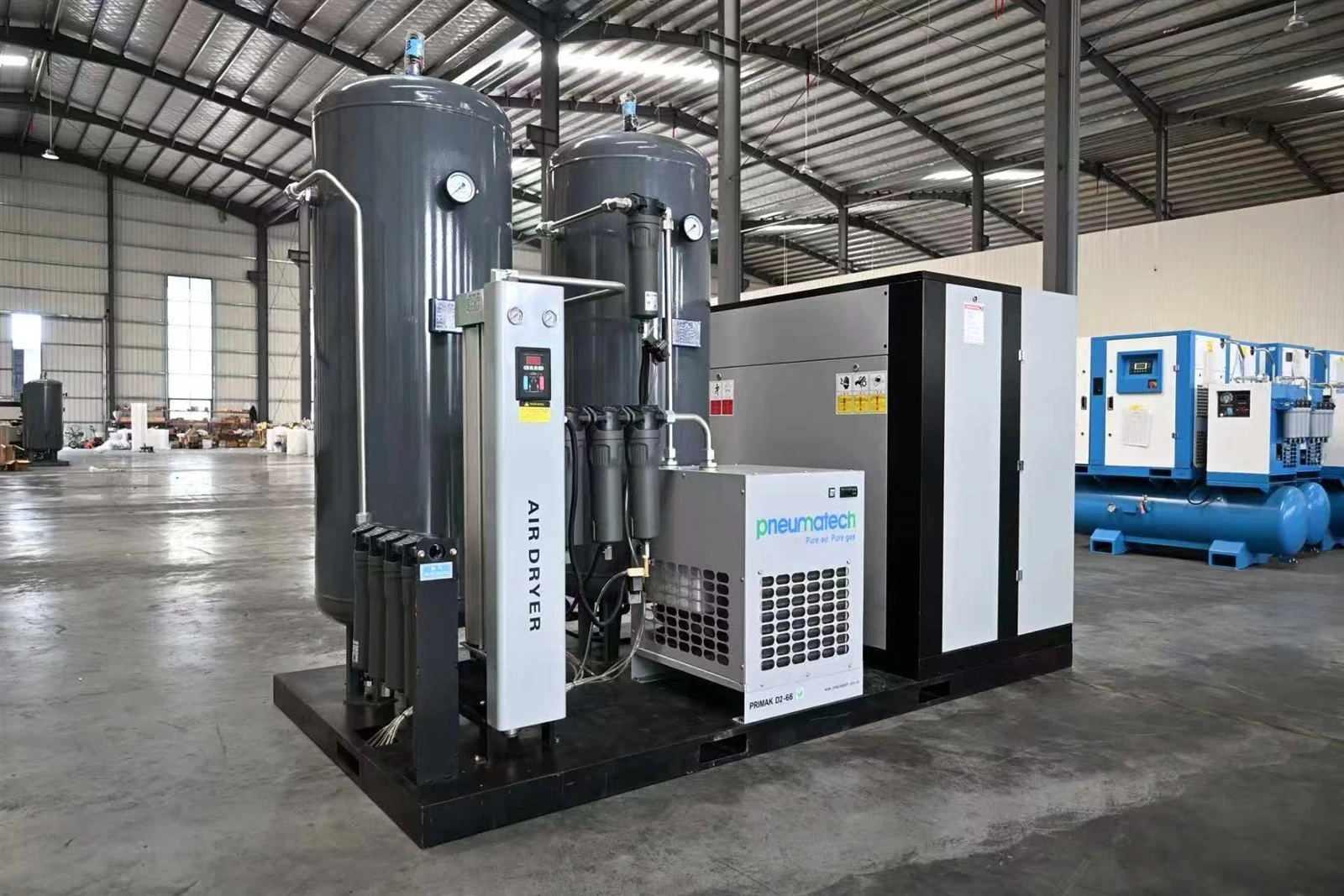
To address such market requirements, HNM permanent-magnet variable-frequency screw air compressors integrate permanent-magnet synchronous motors and variable-frequency control technology to modulate unit operation modes according to real-time air load. In terms of hardware configuration, the complete unit is equipped with a high-performance screw airend, premium-brand permanent-magnet synchronous motors and Inovance inverters. Optimizations are implemented for the oil-gas separation assembly and pipeline layout to minimize redundant energy loss across the whole system. Enhanced heat-dissipation configurations are deployed to cope with harsh industrial conditions featuring high temperature and high humidity, ensuring comprehensive long-term operational stability.
For application scenarios with fluctuating air loads such as laser cutting and general manufacturing, permanent-magnet variable-frequency solutions help enterprises cut operating costs, stabilize air supply pressure, reduce idle-work energy loss and extend equipment service life.
II. From Basic Compressed-air Supply to Targeted Air Quality: Rising Demand for Oil-free Solutions
A prominent ongoing trend in the air compressor industry is growing downstream requirements for compressed-air quality. In sectors including food & beverage, pharmaceuticals & healthcare, electronics & semiconductors and precision manufacturing, compressed air comes into direct or indirect contact with finished products and critical production equipment. Oil-contamination risks have become a major regulatory concern, driving sustained market demand for oil-free air compressors.
Water-lubricated Oil-free Technology: A Differentiated Oil-free Compression Solution
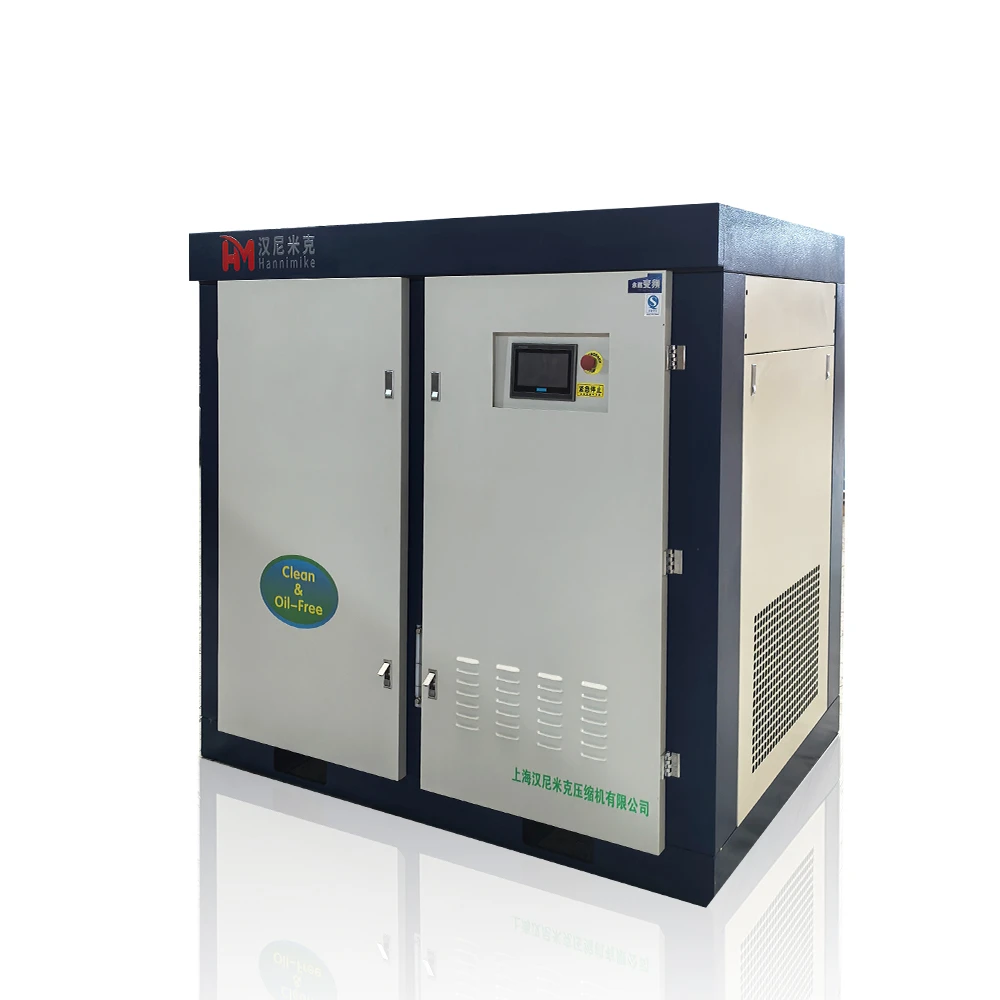
Water-lubricated screw technology uses pure water instead of lubricating oil to perform both lubrication and cooling during compression. Boasting far superior cooling performance compared with oil, water efficiently removes compression heat and brings the compression process closer to isothermal compression, while eliminating oil-contamination risks at source. Consequently, water-lubricated oil-free air compressors deliver notable environmental benefits and offer genuinely reliable oil-free compression for high-purity air-use applications.
HNM water-lubricated oil-free screw air compressors adopt water-lubricated design to eliminate oil contamination hazards from the development stage. Purpose-built for high-purity air-demand scenarios, key components are constructed from corrosion-resistant materials. Dedicated sealing structures fully isolate the compression chamber from bearing zones, achieving complete separation between the air circuit and lubrication system to physically rule out cross-contamination.
Compared with traditional oil-lubricated units, leveraging water's excellent lubricating and cooling properties, this equipment effectively limits compression temperature rise while simplifying peripheral supporting systems. It features a more compact overall structure and enhanced operational stability.
Tailored for industries with stringent requirements for compressed-air cleanliness and operational reliability, such as pharmaceuticals, food processing, electronics and semiconductors, the product provides mature and dependable oil-free compression technology for high-end precision manufacturing.
III. From Standalone Units to Intelligent Systems: Air Compressors Enter the Digital Era
Energy-efficiency improvement and air-quality control address equipment-level performance.
Driven by industrial digitalization, the air compressor industry faces another vital challenge: How can enterprises manage their entire compressed-air system more efficiently?
Traditionally, air compressors were regarded as independently operating mechanical equipment.
Operators would assess equipment health by periodically inspecting parameters such as pressure, temperature and runtime, and perform repairs only after faults occurred.
Thanks to advances in sensors, intelligent controls and IoT technology, modern air compressors are evolving from passively operating machinery into perceptive, analyzable and manageable smart devices.
Continuous collection of operational data enables enterprises to monitor in real-time:
- Stability of system pressure
- Reasonableness of motor load status
- Emerging abnormal trends in discharge temperature
- Degradation of equipment operating efficiency
- Advance scheduling of maintenance work
The value of such data lies in enabling enterprises to shift away from the conventional breakdown-repair model toward condition-based predictive maintenance.
As a result, industry competition is gradually shifting from pure equipment-performance rivalry toward competition over end-to-end system-solution capabilities.
In response to this trend, HNM high-performance screw air compressors incorporate intelligent control technologies to elevate equipment management capacity.
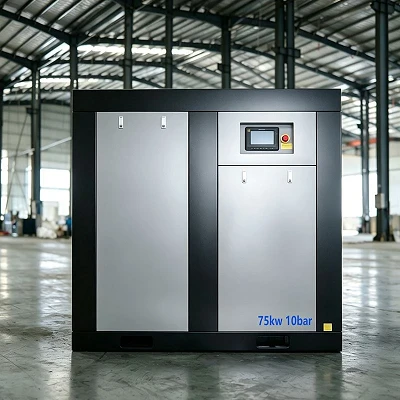
Take the 75 kW permanent-magnet variable-frequency screw air compressor as an example. Fitted with high-efficiency permanent-magnet synchronous motors and advanced variable-frequency drive technology, it dynamically adjusts operating status according to real-time air demand to boost energy utilization efficiency.
Meanwhile, the unit is equipped with an intelligent industrial controller and IoT communication modules for real-time operational-parameter monitoring, equipment-status logging and remote data management support.
Via the digital management platform, enterprises gain intuitive visibility into:
- Equipment operating status
- Variations in key parameters including pressure and temperature
- Historical operation trends
- Maintenance reminders and abnormality alerts
Air compressor management is therefore transitioning from manual routine inspection toward data-driven governance.
In the future, high-performance compressed-air systems will require not only premium hardware but also digital-technology-enabled collaborative optimization across equipment, subsystems and production requirements.
This marks a key pathway for air compressors to evolve from traditional industrial machinery toward smart manufacturing-ready assets.
IV. Future Competition: Beyond "Building a Better Air Compressor"
Global market dynamics indicate that the air compressor industry has reached maturity and is undergoing continuous structural upgrading.
Per Grand View Research, the global air compressor market is projected to reach approximately USD 40.2 billion by 2033 with moderate overall growth. Manufacturing remains a major application sector, while sub-segments such as screw air compressors and oil-free air compressors follow distinct developmental trajectories.
Several clear trends will shape the industry outlook: - Higher efficiency: shifting from standalone equipment efficiency gains toward reduced full-life-cycle operating costs - Superior cleanliness: application-specific compressed-air quality matching for diverse industrial scenarios - Greater intelligence: enhanced operational and maintenance efficiency through sensors, intelligent controls and digital management - Stronger system-orientation: extending beyond single-unit sales toward complete compressed-air system solutions
This means customers may no longer simply purchase a machine that generates compressed air.
What enterprises truly require is a complete compressed-air system capable of stable long-term operation and aligned with production-process demands.
For air-compressor manufacturers, competitive logic is transforming accordingly.
Past competition focused on price, power rating, pressure and flow rate.
Future competition will hinge on energy efficiency, air quality, reliability, intelligence and long-term operational value.
Technological pathways including permanent-magnet variable-frequency control, water-lubricated oil-free compression and intelligent compressed-air systems all reflect one fundamental shift:
Air compressors are transforming from discrete industrial equipment into integral components of industrial enterprises' energy and production ecosystems.


