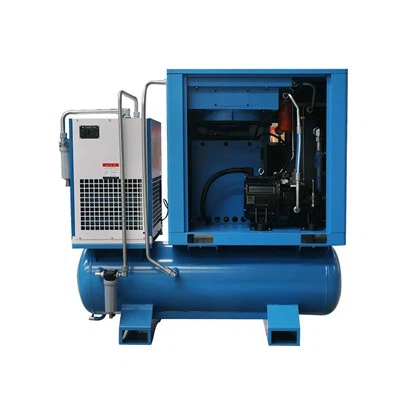
A screw air compressor is a crucial component in many industrial applications, providing a reliable source of compressed air for various processes. However, the quality of the compressed air is equally important, and that's where desiccant air dryers come into play. Desiccant air dryers are designed to remove moisture from the compressed air, preventing corrosion, damage to equipment, and ensuring the efficiency of pneumatic tools and processes. When it comes to desiccant air dryers for screw air compressors, there are two main types: single - tower and twin - tower. In this article, as a supplier of air dryers for screw air compressors, I will explore the differences between these two types in detail.
Working Principle
Single - tower Desiccant Air Dryer
The single - tower desiccant air dryer operates on a relatively simple principle. It consists of a single container filled with desiccant material, such as activated alumina or silica gel. The moist compressed air enters the tower and passes through the desiccant bed. The desiccant adsorbs the moisture from the air, allowing dry air to exit the tower.
However, once the desiccant becomes saturated with moisture, it needs to be regenerated. In a single - tower dryer, this regeneration process requires the dryer to be taken offline. This means that the supply of dry compressed air is interrupted during the regeneration phase. This can be a significant drawback in applications where a continuous supply of dry air is essential.
Twin - tower Desiccant Air Dryer
The twin - tower desiccant air dryer solves the problem of continuous air supply. It consists of two towers filled with desiccant material. While one tower is in the adsorption phase, removing moisture from the incoming compressed air, the other tower is in the regeneration phase.
During the regeneration phase, a small portion of the dry air produced by the adsorbing tower is redirected to the other tower. This dry air is heated (in the case of heat - regenerated dryers) or simply used (in the case of heatless dryers) to remove the moisture from the desiccant. Once the regeneration is complete, the towers switch roles, ensuring a continuous supply of dry compressed air.
Moisture Removal Capacity
Single - tower Desiccant Air Dryer
Single - tower desiccant air dryers can effectively remove moisture from the compressed air to a certain extent. They can typically achieve a dew point of around - 40°F (- 40°C), which is suitable for many general industrial applications where moderate moisture control is required.
However, due to the intermittent regeneration process, their overall moisture removal capacity is limited. If the compressed air has a high moisture content or if the demand for dry air is continuous and high, a single - tower dryer may not be able to meet the requirements.
Twin - tower Desiccant Air Dryer
Twin - tower desiccant air dryers are capable of achieving much lower dew points, often as low as - 100°F (- 73°C). This makes them ideal for applications where extremely dry air is necessary, such as in the pharmaceutical, electronics, and food and beverage industries.
The continuous operation of twin - tower dryers also allows them to handle high - volume compressed air streams with a consistently high moisture content. Their superior moisture removal capacity ensures that the compressed air remains dry and free of moisture - related issues.
Energy Consumption
Single - tower Desiccant Air Dryer
Single - tower desiccant air dryers generally have lower initial energy requirements compared to twin - tower dryers. Since they operate in a batch - like mode, they do not require the continuous redirection of dry air for regeneration.
However, the downtime during the regeneration process can lead to inefficiencies in the overall compressed air system. If the supply of dry air is interrupted, other equipment in the system may need to be shut down or operate at reduced capacity, which can result in additional energy losses.
Twin - tower Desiccant Air Dryer
Twin - tower desiccant air dryers can be more energy - intensive, especially in the case of heat - regenerated dryers. The heating process during regeneration requires a significant amount of energy.
On the other hand, modern twin - tower dryers are designed with energy - saving features. For example, some heatless twin - tower dryers use a minimal amount of dry air for regeneration, reducing energy consumption. Additionally, there are Energy Efficient Compressed Air Dryers available in the market that incorporate advanced control systems to optimize energy usage.
Cost
Single - tower Desiccant Air Dryer
Single - tower desiccant air dryers are generally less expensive to purchase compared to twin - tower dryers. Their simpler design and fewer components contribute to the lower upfront cost.
However, when considering the long - term cost, the intermittent operation and potential downtime of single - tower dryers need to be taken into account. The cost of interrupting production or the additional maintenance required to deal with moisture - related issues in the compressed air system can add up over time.
Twin - tower Desiccant Air Dryer
Twin - tower desiccant air dryers have a higher initial purchase price due to their more complex design and additional components. But their continuous operation and superior moisture removal capabilities can result in long - term cost savings.
By providing a consistent supply of dry air, twin - tower dryers can reduce the wear and tear on equipment, minimize the risk of product contamination, and improve the overall efficiency of the compressed air system. This can lead to lower maintenance costs and increased productivity in the long run.
Applications
Single - tower Desiccant Air Dryer
Single - tower desiccant air dryers are suitable for applications where a continuous supply of dry air is not critical and the moisture requirements are relatively moderate. Some examples include small - scale manufacturing processes, paint spraying, and general workshop operations.


In these applications, the occasional downtime during the regeneration process can be tolerated, and the lower cost of the single - tower dryer makes it an attractive option.
Twin - tower Desiccant Air Dryer
Twin - tower desiccant air dryers are essential for applications where a continuous and extremely dry air supply is required. Industries such as electronics manufacturing, where moisture can cause damage to sensitive components, and the pharmaceutical industry, where air quality is strictly regulated, rely heavily on twin - tower dryers.
They are also commonly used in large - scale industrial plants that require a high volume of dry compressed air for continuous operation, such as chemical processing plants and automotive manufacturing facilities.
Conclusion
In summary, the choice between a single - tower and twin - tower desiccant air dryer for a screw air compressor depends on several factors, including the specific requirements of the application, the desired moisture removal capacity, energy consumption, and cost considerations.
Single - tower desiccant air dryers offer a more cost - effective solution for applications with moderate moisture requirements and non - critical continuous air supply. On the other hand, twin - tower desiccant air dryers provide superior moisture removal, continuous operation, and are better suited for high - demand and sensitive applications.
As a supplier of Air Dryer For Screw Air Compressor, we understand the importance of choosing the right dryer for your specific needs. We offer a wide range of refrigerated and desiccant air dryers, including Refrigerated Compressed Air Dryer and Industrial Air Dryer For Compressor. Our team of experts is always ready to assist you in selecting the most appropriate air dryer for your screw air compressor system.
If you are looking for a reliable and efficient air dryer solution, we encourage you to contact us for a detailed consultation. Our technical support team can provide you with in - depth information, perform on - site evaluations, and help you make an informed decision. Let's work together to ensure the quality and efficiency of your compressed air system.
References
- Compressed Air and Gas Institute (CAGI). Handbook on Compressed Air Systems.
- Air Movement and Control Association International, Inc. (AMCA). Standards for Air Dryers.
- ASHRAE Handbook - HVAC Systems and Equipment.