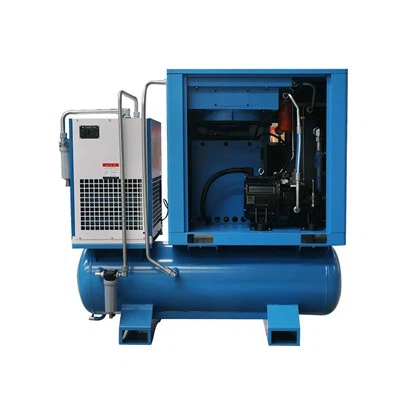
What is the compression ratio of a high - efficiency screw air compressor?
As a supplier of high - efficiency screw air compressors, I often encounter customers who are curious about various technical parameters of our products, and one of the most frequently asked questions is about the compression ratio. In this blog post, I'll delve into what the compression ratio of a high - efficiency screw air compressor is, its importance, and how it impacts the performance of the compressor.
Understanding the Compression Ratio
The compression ratio of a screw air compressor is defined as the ratio of the absolute discharge pressure to the absolute intake pressure. Mathematically, it can be expressed as (r = P_{d}/P_{s}), where (r) is the compression ratio, (P_{d}) is the absolute discharge pressure, and (P_{s}) is the absolute intake pressure.
Let's break this down. The intake pressure is typically the atmospheric pressure when the compressor is operating in a normal environment. For example, at sea level, the standard atmospheric pressure is about 101.3 kPa (14.7 psi). The discharge pressure is the pressure at which the compressed air leaves the compressor. If a compressor has an intake pressure of 101.3 kPa and a discharge pressure of 800 kPa, the compression ratio (r=\frac{800 + 101.3}{101.3}\approx8.9) (we add the atmospheric pressure to the gauge discharge pressure to get the absolute discharge pressure).
Importance of the Compression Ratio
The compression ratio is a crucial factor in determining the performance and efficiency of a screw air compressor.
Energy Efficiency: A higher compression ratio generally means that the compressor has to do more work to compress the air. This can lead to increased energy consumption. However, modern high - efficiency screw air compressors are designed to optimize the compression ratio to achieve a balance between the required discharge pressure and energy efficiency. For instance, by using advanced screw profiles and lubrication systems, we can reduce the energy losses associated with high - compression ratios.


Air Quality: The compression ratio also affects the air quality. Higher compression ratios can cause the air temperature to rise significantly during the compression process. If the temperature gets too high, it can lead to the degradation of the lubricating oil, the formation of carbon deposits, and the production of moisture in the compressed air. Our high - efficiency screw air compressors are equipped with effective cooling systems to control the temperature rise, ensuring high - quality compressed air.
System Performance: The compression ratio is directly related to the performance of the entire compressed air system. If the compression ratio is too low, the compressor may not be able to deliver the required pressure for the end - use applications. On the other hand, if the compression ratio is too high, it can put excessive stress on the compressor components, leading to premature wear and failure.
Factors Affecting the Compression Ratio
Several factors can influence the compression ratio of a high - efficiency screw air compressor.
Screw Profile Design: The design of the screw rotors plays a vital role in determining the compression ratio. Modern screw profiles are designed to provide smooth and efficient compression, allowing for higher compression ratios with less energy consumption. Our engineering team continuously researches and develops new screw profiles to improve the performance of our compressors.
Lubrication and Cooling: Adequate lubrication and cooling are essential for maintaining a stable compression ratio. Lubricants not only reduce friction between the screw rotors but also help in heat dissipation. Cooling systems, such as air - cooled or water - cooled heat exchangers, are used to keep the compressor temperature within a safe range, preventing the negative effects of high temperatures on the compression ratio.
System Pressure Requirements: The specific pressure requirements of the end - use applications determine the desired compression ratio. For example, applications such as pneumatic tools may require a relatively low compression ratio, while industrial processes like laser cutting often demand higher compression ratios to ensure precise and efficient operation.
Compression Ratio in Different Applications
Let's take a look at how the compression ratio varies in some common applications.
Laser Cutting: Laser cutting machines require high - quality compressed air to assist in the cutting process. The compressed air helps to blow away the molten metal and debris, ensuring a clean and precise cut. For laser cutting applications, we offer specialized compressors such as the BOX - TYPE Laser Cutting Air Compressor and the 15kw Screw Air Compressor For Laser Cutting. These compressors are designed to achieve relatively high compression ratios, typically in the range of 7 - 10, to meet the pressure requirements of laser cutting systems. The High Pressure Air Compressor for Laser Cutting 4 - in - 1 is another option for more demanding laser cutting applications, which can provide even higher compression ratios.
Pneumatic Tools: Pneumatic tools, such as impact wrenches and nail guns, usually operate at lower pressures. Compressors for pneumatic tool applications typically have a compression ratio of around 4 - 6. This lower compression ratio is sufficient to provide the required pressure for the proper functioning of the tools while keeping energy consumption relatively low.
Selecting the Right Compression Ratio
When choosing a high - efficiency screw air compressor, it's important to select the right compression ratio based on your specific application requirements. Here are some tips to help you make the right decision:
- Understand Your Application: Determine the required discharge pressure for your end - use applications. If you're using the compressor for a single application, such as a small workshop with pneumatic tools, a lower compression ratio may be sufficient. However, if you have multiple applications with varying pressure requirements or high - performance applications like laser cutting, you may need a compressor with a higher compression ratio.
- Consider Energy Efficiency: Look for compressors that are designed to optimize the compression ratio for energy efficiency. Our high - efficiency screw air compressors are equipped with advanced control systems that can adjust the compression ratio based on the demand, reducing energy consumption and operating costs.
- Consult with an Expert: If you're unsure about which compression ratio is right for your application, don't hesitate to consult with our technical team. We have extensive experience in the field of air compression and can provide you with professional advice based on your specific needs.
In conclusion, the compression ratio of a high - efficiency screw air compressor is a critical parameter that affects its performance, energy efficiency, and air quality. By understanding the concept of the compression ratio and its importance in different applications, you can make an informed decision when selecting a compressor for your business.
If you're interested in learning more about our high - efficiency screw air compressors or have questions about the compression ratio, we'd love to hear from you. Contact us today to start a discussion about your compressed air needs and how our products can meet those requirements. Our team of experts is ready to assist you in finding the perfect solution for your application.
References
- Compressed Air and Gas Handbook by Compressed Air and Gas Institute.
- Principles of Turbo - Machinery by S. L. Dixon.