Hey there! As a supplier of high-quality air dryers for compressors, I often get asked about what air drying uniformity really means. So, let's dig into this topic and break it down in a way that's easy to understand.
First off, what's an air dryer for a compressor? Well, when air is compressed, it gets hot, and as it cools down, moisture condenses. This moisture can cause all sorts of problems in your compressed air system, like corrosion in pipes, damage to pneumatic tools, and reduced efficiency of your equipment. That's where an air dryer steps in. It removes the moisture from the compressed air, making it dry and ready to use in your industrial processes.
Now, let's talk about air drying uniformity. Simply put, it's how evenly the air dryer removes moisture from the compressed air across its entire output. A high-quality air dryer should ensure that every part of the compressed air stream has the same low level of moisture. Why is this so important?
Imagine you're running a manufacturing process that relies on compressed air. If the air isn't uniformly dry, some parts of your equipment might receive dry air, while others get air with a higher moisture content. This can lead to inconsistent performance. For example, in a painting process, if the compressed air used to spray paint has varying moisture levels, the paint finish might be uneven, with some areas looking dull or having a different texture.
In a high-pressure environment, like in a screw air compressor, non-uniform drying can also cause issues. Moisture can accumulate in certain parts of the system, leading to blockages or increased wear and tear on components. This not only affects the quality of your end product but also increases maintenance costs and downtime.
So, how does a high-quality air dryer achieve good air drying uniformity? There are a few key factors at play.
One of the most important is the design of the dryer. A well-designed air dryer will have a proper flow path for the compressed air. This ensures that the air moves through the drying medium (like desiccant beads in a desiccant dryer or heat exchangers in a refrigerated dryer) evenly. If the air flow is too turbulent or if there are dead spots in the dryer, some of the air might not come into contact with the drying elements effectively, resulting in uneven drying.
Another factor is the quality of the drying medium itself. In a desiccant dryer, for example, the desiccant beads need to have a consistent adsorption capacity. If some beads are more effective at removing moisture than others, it can lead to non-uniform drying. That's why we, as a high-quality air dryer supplier, always use top-notch desiccant materials and make sure they're properly maintained and replaced when needed.
The control system of the air dryer also plays a crucial role. A good control system can monitor the moisture level of the output air and adjust the drying process accordingly. For instance, in a refrigerated dryer, the control system can regulate the temperature of the refrigerant to ensure that the air is cooled to the right level to remove the moisture uniformly.
Now, let's talk about the different types of air dryers and how they relate to air drying uniformity.
Refrigerated air dryers are one of the most common types. They work by cooling the compressed air to a low temperature, causing the moisture to condense and be removed. These dryers are generally quite good at achieving uniform drying, especially when they're properly sized for the application. The heat exchangers in a refrigerated dryer are designed to ensure that the air is cooled evenly across the entire flow. You can learn more about Energy Efficient Compressed Air Dryers on our website.
Desiccant air dryers, on the other hand, use a desiccant material to adsorb the moisture from the compressed air. These dryers can achieve very low dew points, which is great for applications that require extremely dry air. However, to ensure uniform drying, the desiccant beds need to be properly designed and maintained. We offer Industrial Air Dryer For Compressor options that are designed to provide excellent air drying uniformity, whether you're using a single desiccant bed or a twin-tower system.
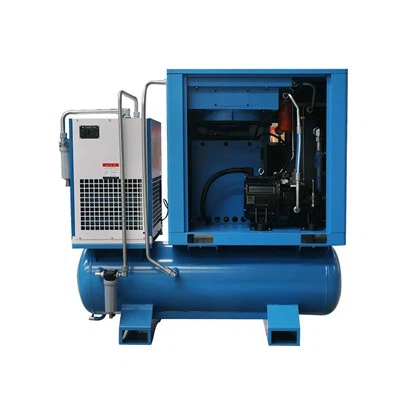
For screw air compressors, specific air dryers are often required. These dryers need to be able to handle the high-pressure and high-volume air flow of the compressor. Our Air Dryer for Screw Air Compressor is designed to provide uniform drying even in these demanding conditions. The design takes into account the unique characteristics of screw compressors, such as the pulsating air flow, to ensure that the air is dried evenly across the entire output.


In addition to the technical aspects, choosing the right air dryer for your specific application is also crucial for achieving good air drying uniformity. You need to consider factors like the flow rate of your compressed air, the desired dew point, and the operating environment. Our team of experts can help you select the best air dryer for your needs, ensuring that you get the most uniform and efficient drying possible.
If you're in the market for a high-quality air dryer for your compressor, don't hesitate to reach out to us. We have a wide range of air dryers that are designed to provide excellent air drying uniformity, backed by our years of experience and commitment to quality. Whether you're a small business or a large industrial operation, we can find the right solution for you. Contact us today to start the conversation and see how we can help you improve the performance of your compressed air system.
References
- Compressed Air and Gas Handbook, by the Compressed Air and Gas Institute
- Air Treatment Handbook, by various industry experts