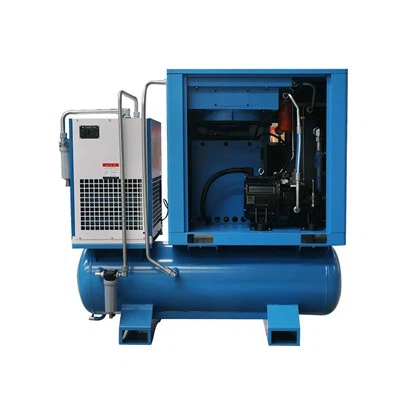
Hey there! As a supplier of high - efficiency screw air compressors, I've seen firsthand the challenges that come with handling the exhaust heat of these powerful machines. In this blog, I'll share some practical tips on how to manage this issue effectively.
Why is Exhaust Heat a Problem?
Let's start by understanding why exhaust heat is such a big deal. High - efficiency screw air compressors work hard to compress air, and during this process, a significant amount of heat is generated. If this heat isn't managed properly, it can lead to a bunch of problems. For one, it can reduce the efficiency of the compressor. When the compressor gets too hot, it has to work harder to maintain the same level of performance, which means more energy consumption and higher operating costs.
Moreover, excessive heat can also damage the internal components of the compressor. The seals, gaskets, and lubricants can break down under high temperatures, leading to leaks and premature wear and tear. This not only shortens the lifespan of the compressor but also increases the frequency of maintenance and repair, which can be a real headache for users.
Methods to Handle Exhaust Heat
1. Adequate Ventilation
One of the simplest and most effective ways to handle exhaust heat is to ensure adequate ventilation in the compressor room. The compressor should be installed in a well - ventilated area with enough space around it. Make sure there are no obstructions blocking the airflow. You can also install exhaust fans to help remove the hot air from the room.
For example, if you have a small compressor room, a couple of wall - mounted exhaust fans can do the trick. They can be set to run continuously or based on the temperature inside the room. This way, the hot air is constantly being replaced with cooler air from outside, keeping the compressor at a reasonable operating temperature.


2. Heat Exchangers
Heat exchangers are another great option for managing exhaust heat. These devices work by transferring the heat from the compressed air to a cooling medium, such as water or air. There are different types of heat exchangers available, including air - cooled and water - cooled ones.
Air - cooled heat exchangers are relatively simple and cost - effective. They use fans to blow air over the hot surfaces of the exchanger, dissipating the heat into the surrounding environment. Water - cooled heat exchangers, on the other hand, are more efficient but require a water supply and a proper drainage system. They are often used in larger industrial settings where high - volume heat removal is needed.
3. Insulation
Insulating the compressor and its piping can also help in handling exhaust heat. By reducing the heat transfer from the compressor to the surrounding environment, insulation can keep the compressor room cooler and prevent heat from being wasted. You can use insulation materials such as fiberglass or foam to wrap the compressor and the pipes.
This not only helps in heat management but also reduces noise levels. The insulation acts as a sound barrier, absorbing the vibrations and noise generated by the compressor. So, it's a win - win situation!
Our High - Efficiency Screw Air Compressors
At our company, we offer a range of high - efficiency screw air compressors designed to minimize exhaust heat issues. Our BOX - TYPE Laser Cutting Air Compressor is a great example. It's built with advanced technology to ensure efficient operation and low heat generation. The box - type design provides better protection and insulation, reducing the impact of exhaust heat on the surrounding environment.
We also have the Box - type Screw Air Compressor, which is suitable for various industrial applications. It comes with a high - performance cooling system that effectively handles the exhaust heat, ensuring long - term reliability and performance.
And for those who need a compressor for laser cutting applications, our 15kw 16bar Screw Air Compressor For 1500w Laser Cutting is a top - notch choice. It's specifically designed to meet the high - demand requirements of laser cutting machines while keeping the heat under control.
Conclusion
Handling the exhaust heat of a high - efficiency screw air compressor is crucial for its performance, longevity, and cost - effectiveness. By implementing proper ventilation, using heat exchangers, and adding insulation, you can effectively manage the heat and avoid potential problems.
If you're in the market for a high - efficiency screw air compressor or need more information on how to handle exhaust heat, don't hesitate to get in touch with us. We're here to help you find the best solution for your specific needs. Whether you're a small business or a large industrial enterprise, we have the right compressor for you. So, let's start a conversation and see how we can work together to improve your operations.
References
- Compressed Air and Gas Handbook, 4th Edition
- Industrial Compressor Systems: Operation, Maintenance, and Troubleshooting