

If you're running a laser cutting operation, odds are you've spent hours troubleshooting why your cuts aren't as clean as they should be, or why your compressor is overheating mid-job. I work with tons of shops that rely on integrated air compressors for laser cutting every single day, and one question comes up more than any other: "What's the thickest material these little (or not-so-little) units can actually handle?"
It's not a one-size-fits-all answer, by the way. I've seen guys try to cram 1-inch steel through a tiny 5HP unit and wonder why their laser keeps cutting out, and others use a 50HP model to cut 1/4-inch aluminum, wasting half their power bill. Let's break this down like we're chatting over a coffee after a long day of running machines-no overly technical jargon, just real stuff that actually works.
First, let's get one basic fact straight: integrated air compressors for laser cutting aren't your average shop air compressors. They're built specifically to deliver the exact pressure and volume (that's CFM, for the uninitiated) laser cutters need, without the extra bulk of a separate dryer, tank, or filtration system. That design is where the thickness limit lives.
Let's start with the most common material people cut: mild steel. For thin stuff-like 16 gauge (about 1.5mm) up to 1/4 inch (6mm)-any mid-tier integrated unit will handle that no problem. But when you jump to 1/2 inch (12mm), that's where pressure and CFM start to matter. Mild steel needs oxygen as an assist gas, right? And oxygen burns hotter than air, but it still relies on consistent pressure to blow the molten metal out of the cut. Most standard integrated compressors top out around 150 PSI, which works fine for 1/2-inch mild steel. But go thicker-like 3/4 inch (19mm) or 1 inch (25mm)-and you need a unit that can hold that pressure and deliver enough CFM to keep up with the laser's power. A lot of entry-level integrated models will choke here; they can push 150 PSI, but they can only do it at 15 CFM, which is too little for a high-powered laser cutting thick metal. That's why shops that run a lot of heavy mild steel work usually go for a beefier setup.
Stainless steel is a whole different beast. It's denser than mild steel, so it needs a higher-pressure assist gas too-usually nitrogen. Nitrogen is more expensive, but it gives a cleaner cut. For thin stainless (up to 1/8 inch, 3mm), you don't need anything crazy. But when you get to 1/4 inch (6mm), that pressure ramps up. Most integrated compressors are rated for nitrogen, but not all can sustain the 180–200 PSI you need for 1/2-inch stainless. I've had customers try to cut 5/8-inch (16mm) stainless with a basic integrated unit and come back with cut edges that are rough and full of dross-all because their compressor couldn't hold that steady high pressure long enough. For stainless thicker than 1/2 inch, you're probably looking at a dedicated high-performance model, but wait-don't sleep on the right pick here.
Aluminum is the wild card of laser cutting. It's reflective, so you need a laser with enough power to cut it, and the assist gas (usually nitrogen or sometimes compressed air) needs to be strong enough to blow the molten aluminum away before it damages the lens. Thin aluminum is easy-any integrated unit works. But when you get to 1/4 inch (6mm), that's where things get tricky. Aluminum's melting point is lower than steel, so the key is volume (CFM) over pressure. You need enough air flow to keep the cut cool and flush the material fast. If your integrated compressor only puts out 20 CFM, you'll struggle with 1/4-inch aluminum; bump that up to 30–35 CFM, and it's smooth sailing. For thicker aluminum-like 3/8 inch (10mm)-you might need to step up to a more powerful unit, but again, it's not just about brute size. I've seen a smaller 30HP integrated unit outperform a 50HP entry-level one on aluminum, because the smaller model was optimized for CFM delivery instead of just pressure.
Now, let's talk about the factors that actually set that thickness limit, because this is where most guys guess wrong. First, CFM per HP. A lot of people think more HP = thicker cuts, but that's not true. It's how much CFM (air flow) you get for each horsepower, and how steady that flow is. Integrated compressors that are built for laser cutting have better control systems-they adjust pressure in real-time to match the laser's speed, which is huge for thick materials. A standard shop compressor will dip in pressure when the laser is running at full speed, leading to bad cuts on thick stuff.
Second, filtration and air dryers. If your air has water or oil in it, that's a showstopper for thick cuts. Water can create little explosions in the cut, and oil leaves a rough, smoky edge. Integrated air compressors for laser cutting come with built-in dryers and filtration, so you don't have to add them on. Skip that, and even the most powerful unit will max out at thin material. I once had a customer who swore his integrated compressor was garbage for thick steel-turns out he had the filter set to "basic" instead of "high-efficiency," and the dirty air was cutting his CFM by 30%. Fixed the filter, and he was cutting 1-inch steel no problem.
Third, laser power pairing. This is the big one. If you have a 2kW laser, an integrated compressor that handles 1-inch steel is perfect. But if you have a 4kW laser, you need a compressor that can keep up with that extra power-because the 4kW laser is burning through more material, which needs more air to blow it out. Mismatch the two, and your thickness limit drops fast. I see this all the time: a guy buys a cheap integrated compressor when he gets a 4kW laser, and then wonders why he can't cut more than 1/2-inch steel. The compressor is holding him back, not the laser.
So let's get to the real numbers, the stuff you can actually use. Based on what I see in shops every day, here's a rough guide for integrated air compressors for laser cutting:
- Entry-level units (10–20HP): Max thickness is ~1/4-inch (6mm) mild steel, ~1/8-inch (3mm) stainless, ~3/16-inch (5mm) aluminum. Great for small shops or hobbyists running thin material mostly.
- Mid-tier units (25–40HP): Max thickness is ~1/2-inch (12mm) mild steel, ~1/4-inch (6mm) stainless, ~1/4-inch (6mm) aluminum. This is the sweet spot for most small to medium fabrication shops, handling 90% of common laser cutting jobs.
- High-performance units (45–100HP): Max thickness here jumps to ~1-inch (25mm) mild steel, ~3/4-inch (19mm) stainless, ~3/8-inch (10mm) aluminum. These are for shops that do heavy industrial work, or cut thick material on a regular basis.
Wait, but hold on-those are general numbers, right? I've had customers with a 30HP mid-tier unit cut 3/4-inch mild steel, if they're using oxygen as the assist gas and running the laser at a slower speed. But that's pushing the limit, and you'll get more dross than if you used a high-performance unit. The numbers above are for consistent, high-quality cuts-not just "I can get through it if I baby it."
Now, let's talk about a mistake I see all the time: people buy the biggest compressor they can afford, just to be safe, and end up wasting money. A 100HP unit will use way more electricity than you need if you only cut 1/4-inch steel. It's like driving a semi-truck to the grocery store-overkill, and expensive. That's why integrated units are so good, because they're sized to match typical laser cutting workloads.
If you're in the market for a compressor, let's take a quick look at the options we've got, since I work with these every day. For example, our Professional Laser Cutting Screw Air Compressor is built with precision pressure control and optimized CFM delivery, so you don't have to guess at whether it'll handle thick mild steel or stainless. We also have the Screw All In One Air Compressor for Laser Cutting, which is super compact-perfect for small shops with limited space, and it still holds up for thick cuts when you need it. If you're worried about power bills, the Energy-saving laser cutting screw air compressor uses variable speed technology to adjust air flow based on what you're cutting, so you don't waste energy idling. For folks with lower-power lasers, the 11kw vfd screw air compressor Hannemec is a solid pick, and if you're running heavy-duty industrial jobs, the 100 HP Rotary Screw Air Compressor will push through that thick steel or stainless without breaking a sweat.
But here's the thing: even the best compressor won't hit its max thickness limit if your setup is off. Let's recap the little things that make a huge difference for thick cuts:
- Keep your filters clean. I recommend checking them every 3 months, more if you run the machine 24/7.
- Use the right assist gas. Oxygen for mild steel (hotter burns, better for thick stuff), nitrogen for stainless/aluminum (cleaner cuts, needs consistent high pressure).
- Match your laser power to your compressor. A 2kW laser doesn't need a 100HP compressor, but a 6kW laser definitely needs that high-performance unit.
- Don't ignore maintenance. A well-tuned integrated compressor will handle thick cuts for years; a neglected one will struggle even with thin material.
Wait, let's test this with a real example. Last month, a customer came to me who had a entry-level integrated compressor and couldn't cut anything thicker than 1/4-inch mild steel. He was using a 2kW laser, so he upgraded to our mid-tier Screw All In One Air Compressor for Laser Cutting. Within a week, he was cutting 3/4-inch mild steel with zero dross, and his electricity bill only went up 15%-way less than he expected. He wasn't buying a bigger laser, just a compressor that could keep up with the laser's power when cutting thick metal. That's the kind of win that makes this job worth it.
Another example: a fabrication shop that does a lot of custom stainless parts. They were using a standard shop compressor (not integrated) for years, and their cuts on 1/2-inch stainless were rough, with a lot of finishing work. They switched to our Professional Laser Cutting Screw Air Compressor, which has a built-in nitrogen regulator that keeps pressure steady at 190 PSI. Now their stainless cuts on 1/2-inch are clean enough that they skip the grinding step, saving them hours every week.
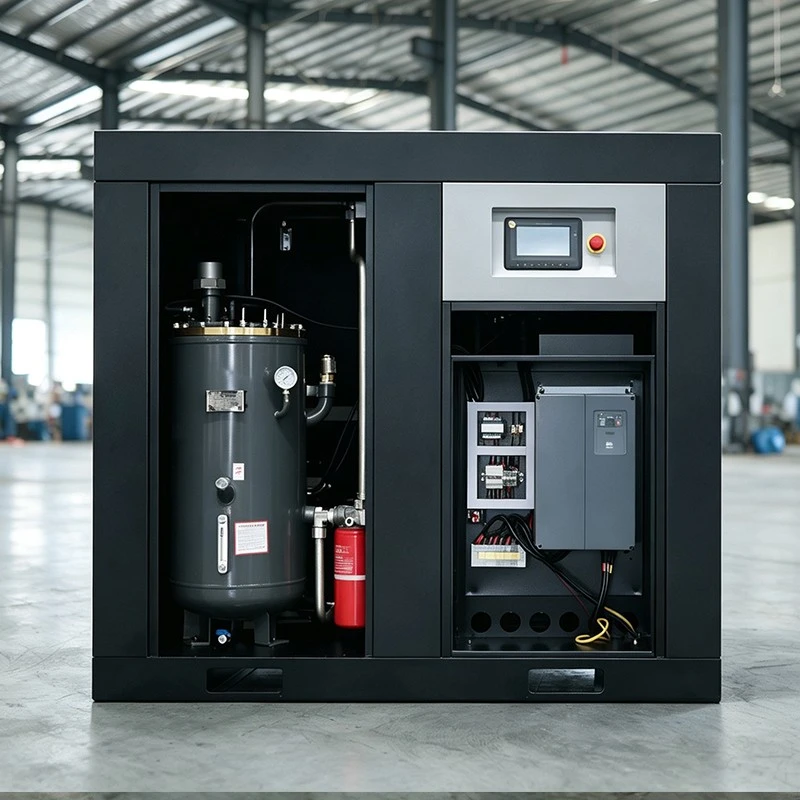

Now, let's address a common myth: "Integrated compressors can't handle thick material like big standalone compressors." Yeah, that was true 10 years ago. But technology has changed. Modern integrated units have variable speed drives, better filtration, and precision pressure control that makes them just as capable as standalone setups-without the extra parts taking up space. The only time you need a standalone is if you're cutting really thick stuff-like 2-inch steel, which is rare for most shops. For 99% of laser cutting jobs, integrated units are more than enough, and they're way easier to maintain.
So, to wrap this up, the maximum thickness an integrated air compressor can handle for laser cutting isn't a number you can pull out of a manual. It depends on what material you're cutting, what laser power you have, how good your compressor's pressure and CFM delivery is, and how well you maintain it. For most shops, if you pick the right sized mid-tier unit, you'll handle up to 1/2-inch mild steel, 1/4-inch stainless, and 1/4-inch aluminum with no problems. If you're doing heavy industrial work, step up to a high-performance unit, and you can go up to 1-inch mild steel or 3/4-inch stainless.
If you're trying to figure out which compressor is right for your shop, don't just guess based on HP or CFM. Talk to someone who actually works with these units every day-someone who knows how to match your laser to your workload, so you don't end up with a compressor that's too small, too big, or not built for the material you cut most. Whether you're a small hobbyist doing thin stuff or a big industrial shop cutting thick steel, there's an integrated air compressor for laser cutting that'll handle the job, without wasting your money or your time.
If you've been struggling with cuts that are too thin, too rough, or just not consistent, or you're ready to upgrade and stop guessing about thickness limits, reach out to us to chat through your setup. We can help you find the right unit for your needs, no sales pitch, just real advice from people who know laser cutting and compressors inside and out.
References
- Laser Cutting Fundamentals: Assist Gas Requirements and Pressure Specifications, Fabricator's Guide, 2023
- Rotary Screw Air Compressor Performance for Laser Cutting Applications, Industrial Air Solutions, 2024
- Material Thickness vs. Laser Power and Compressor CFM, SME Metalworking Journal, 2023
- Integrated Compressor Design Best Practices for Laser Cutting, Industrial Maintenance Magazine, 2024


