

The compressor is a core component of a refrigeration compressed air dryer, and its type significantly impacts the dryer's performance. As a supplier of refrigeration compressed air dryers, understanding these effects is essential to provide customers with the best solutions. In this article, we will explore how different compressor types influence the performance of refrigeration compressed air dryers.
The Role of Compressors in Refrigeration Compressed Air Dryers
Before delving into the effects of compressor types, it is crucial to understand the role of compressors in refrigeration compressed air dryers. A refrigeration compressor in these dryers is responsible for compressing the refrigerant gas, raising its pressure and temperature. This high - pressure, high - temperature gas then moves through the condenser, where it releases heat and condenses into a liquid. The liquid refrigerant then passes through an expansion valve, causing a drop in pressure and temperature. Finally, it enters the evaporator, where it absorbs heat from the compressed air, cooling the air and causing water vapor to condense out.
Types of Compressors and Their Impact on Performance
Reciprocating Compressors
Reciprocating compressors are one of the oldest and most commonly used types in refrigeration applications. They work by using a piston - cylinder arrangement to compress the refrigerant gas.
- Efficiency: Reciprocating compressors can be highly efficient at partial loads. They can adjust their capacity by varying the number of active cylinders or by using variable - speed drives. However, at full load, their efficiency may be lower compared to some other compressor types. In a refrigeration compressed air dryer, this can translate to higher energy consumption, especially when the dryer is operating continuously at maximum capacity.
- Capacity: These compressors are available in a wide range of capacities, making them suitable for small to medium - sized refrigeration compressed air dryers. For small workshops or laboratories that require a relatively low flow rate of dry compressed air, reciprocating compressors can provide a cost - effective solution.
- Noise and Vibration: One of the main drawbacks of reciprocating compressors is the noise and vibration they generate. The piston - cylinder movement creates mechanical vibrations, which can be transmitted to the surrounding environment. This can be a concern in noise - sensitive areas such as hospitals or office buildings. As a refrigeration compressed air dryer supplier, we need to ensure that proper vibration isolation and noise reduction measures are in place when using reciprocating compressors. High Quality Air Dryer for Compressor
Rotary Screw Compressors
Rotary screw compressors use two intermeshing helical screws to compress the refrigerant gas.

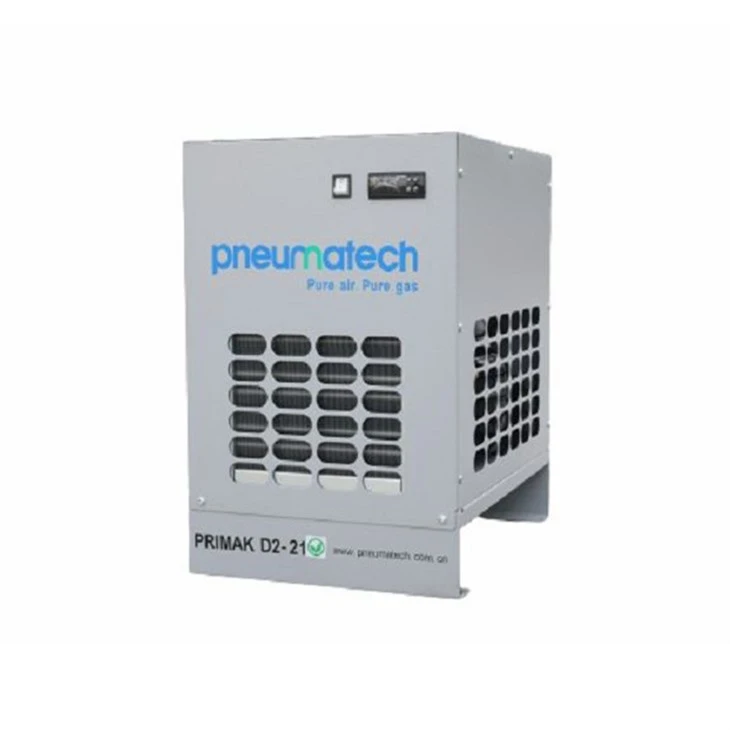
- Efficiency: Rotary screw compressors are known for their high efficiency, especially at full load. They have a relatively simple design with fewer moving parts compared to reciprocating compressors, which reduces mechanical losses. In a refrigeration compressed air dryer, this means lower energy consumption and lower operating costs over the long term.
- Capacity: These compressors can handle large capacities, making them suitable for industrial applications where a high flow rate of dry compressed air is required. For industrial plants with multiple pneumatic tools and equipment, Industrial Air Dryer For Compressor equipped with rotary screw compressors can meet the demand effectively.
- Reliability: Rotary screw compressors are generally more reliable than reciprocating compressors due to their fewer moving parts and smoother operation. They have a longer service life and require less maintenance, which is an important factor for many customers. However, they are also more expensive to purchase initially, which can be a consideration for budget - conscious buyers.
Scroll Compressors
Scroll compressors operate using two spiral - shaped scrolls, one fixed and one orbiting, to compress the refrigerant gas.
- Efficiency: Scroll compressors are highly efficient, particularly at low to medium loads. They have a continuous compression process, which reduces pressure pulsations and improves overall efficiency. In a refrigeration compressed air dryer, this can result in significant energy savings, especially when the dryer is operating at variable loads.
- Noise and Size: These compressors are relatively quiet and compact, making them suitable for applications where space is limited or noise needs to be minimized. For example, in small manufacturing facilities or dental offices, scroll compressors can be an ideal choice for Refrigeration Compressed Air Dryer due to their small footprint and quiet operation.
- Capacity Limitations: However, scroll compressors have limitations in terms of capacity. They are generally suitable for small to medium - sized applications and may not be able to meet the high - capacity requirements of large industrial plants.
Impact on Drying Performance
The type of compressor also affects the drying performance of a refrigeration compressed air dryer.
- Dew Point Stability: A compressor with better efficiency and consistent performance can help maintain a stable dew point. Rotary screw and scroll compressors, with their smooth operation and high efficiency, are more likely to provide a stable dew point compared to reciprocating compressors, which may have fluctuations in pressure and capacity.
- Moisture Removal Efficiency: The ability of the compressor to compress the refrigerant effectively influences the amount of heat that can be absorbed from the compressed air. Compressors with higher efficiency, such as rotary screw and scroll compressors, can often remove more moisture from the air, resulting in drier compressed air.
Other Considerations
In addition to the performance factors mentioned above, there are other considerations when choosing a compressor for a refrigeration compressed air dryer.
- Environmental Impact: The type of refrigerant used and the energy efficiency of the compressor can have an impact on the environment. For example, compressors that use natural refrigerants or have high energy efficiency ratings can help reduce greenhouse gas emissions.
- Cost: The initial cost of the compressor, as well as the operating and maintenance costs, are important factors for customers. Reciprocating compressors are generally less expensive to purchase, but they may have higher operating costs due to lower efficiency. Rotary screw and scroll compressors, while more expensive upfront, can offer lower operating costs in the long run.
Conclusion
As a supplier of refrigeration compressed air dryers, we understand that the choice of compressor type has a profound impact on the performance, efficiency, and cost - effectiveness of the dryer. By carefully considering the specific requirements of each application, such as capacity, energy efficiency, noise level, and dew point stability, we can recommend the most suitable compressor type for our customers.
Whether you are a small workshop looking for a compact and cost - effective solution or a large industrial plant in need of high - capacity and reliable performance, we have the expertise to provide you with the best refrigeration compressed air dryer. If you are interested in learning more about our products or have specific requirements for your application, we welcome you to contact us for a detailed discussion and a customized solution. We look forward to the opportunity to work with you and help you achieve optimal performance from your compressed air drying system.
References
- ASHRAE Handbook - Refrigeration.
- Compressor Handbook, various editions.
- Journal articles on refrigeration technology and compressed air drying.


